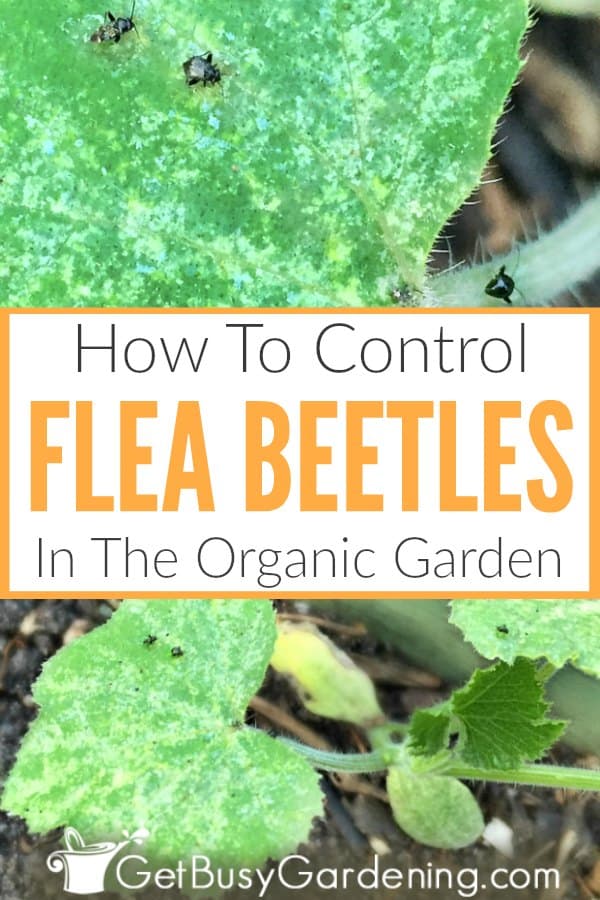
Flea beetles are tiny yet extremely destructive garden pests. But you can control their population and prevent them from destroying your plants.
In this complete guide, I will show you all you need to know about how to manage them and ensure they cause minimal damage to your garden.
You’ll learn all about these annoying little bugs, including how to identify them, what type of damage they do, prevention tips, and lots of effective organic treatment methods you can use to fight them.
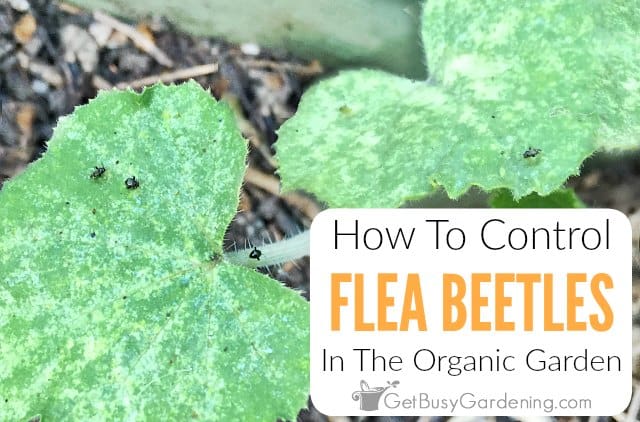

I remember when flea beetles first invaded my garden several years ago. There were hundreds of them jumping around on the soil and all over my plants. It seemed like they were everywhere I looked and, not only were they decimating my seedlings, it was disgusting.
I immediately went to work to figure out the best ways to get rid of them quickly, and save my garden. It turns out that it’s not too difficult, whew!
The good news is that you don’t have to reach for the chemical pesticides, there are several ways to control them naturally using organic methods and techniques.
What Are Flea Beetles?
Flea beetles are small, hard-shelled insects that feed on plants by sucking the sap out of the leaves or chewing tiny holes.
They can be very destructive in the garden in early spring, and a large population will quickly kill immature plants and seedlings.
Though they aren’t actually related to fleas, they get their common name because they have large back legs that allow them to jump.
What Do They Look Like?
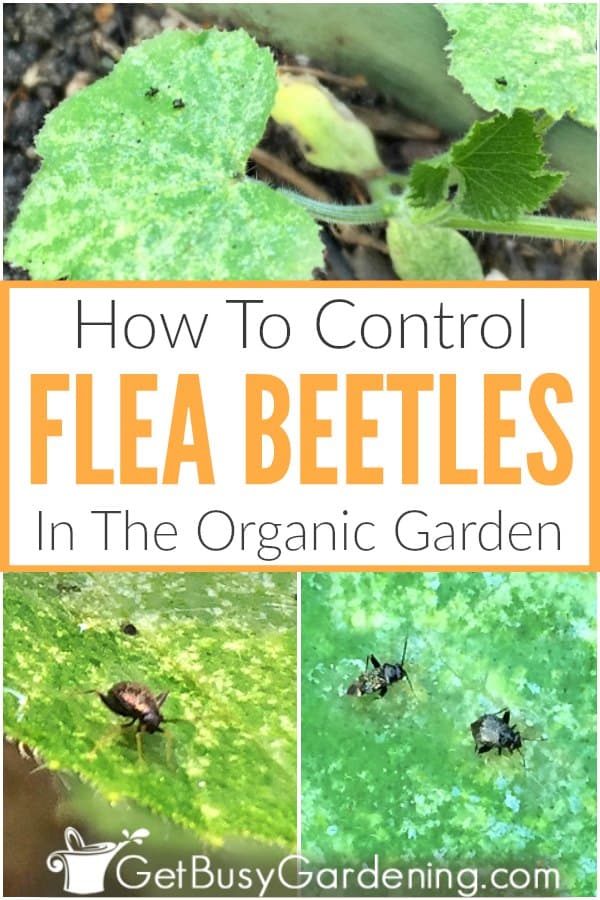
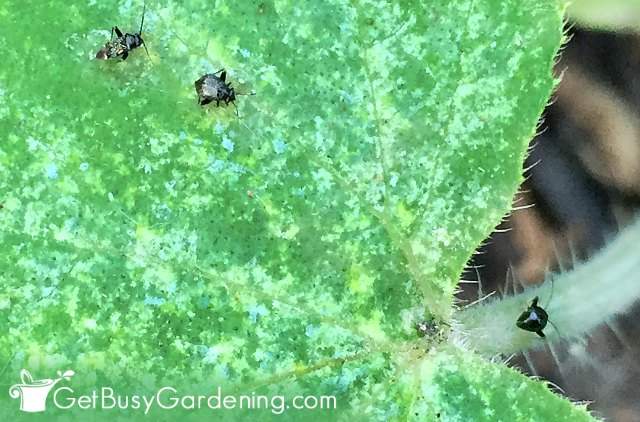
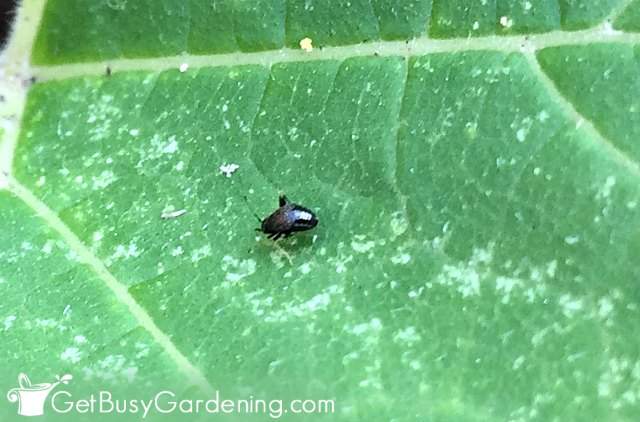
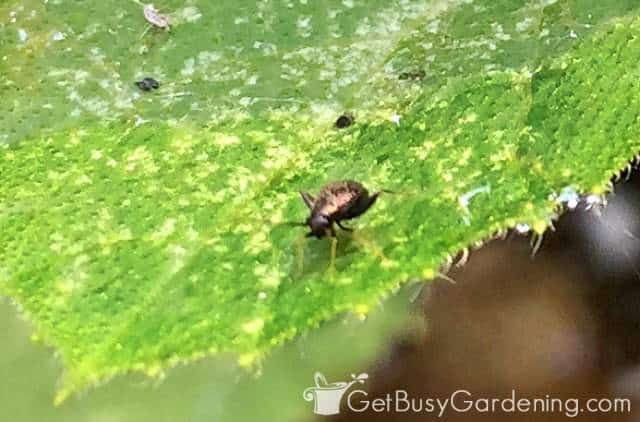
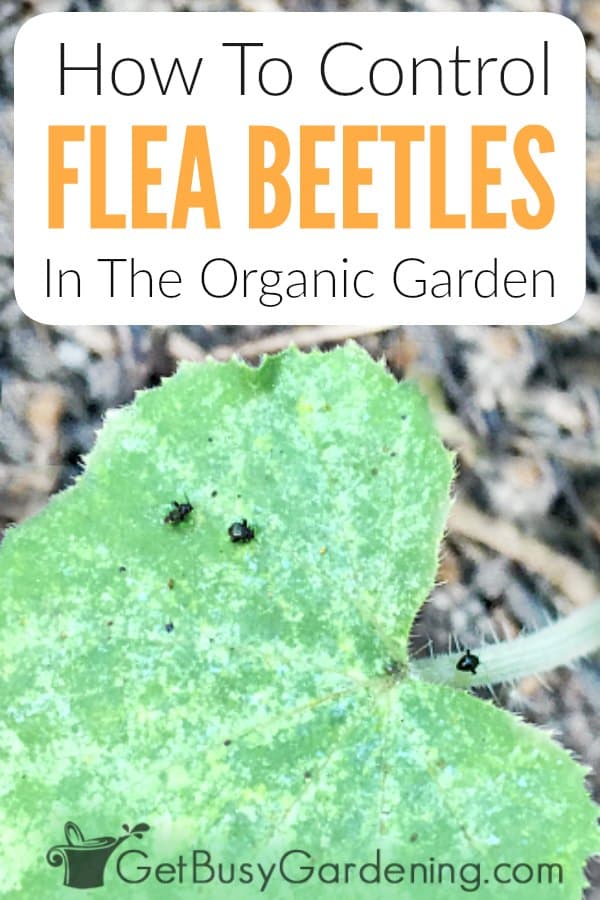
Up close, flea beetles look like tiny beetles. They’re shiny, and can be black, brown, or bluish in color. Some species may even have spots or stripes.
They’re very small, so from far away they look like black or brown specks on the leaves of a plant. It’s hard to see them from a distance, so they can easily go unnoticed.
A quick way to make a positive identification is to disturb the plant or surrounding soil. They’ll start jumping around like fleas when they are disturbed.
Life Cycle
To successfully control flea beetles in your garden, it’s important to understand their life cycle. There are 4 stages: eggs, larvae, pupae, and adults.
The adult females can lay their eggs on plants or in the soil. Once they hatch, the larvae are minute white worms that are barely visible to the naked eye. The larvae live in the soil, and feed on the roots of the plants.
After several weeks they pupate, and new adults emerge a few days later. There can be more than one generation per growing season, depending on where you live.
The adult beetles hibernate in the soil or in plant debris through the winter. They emerge as soon as it warms up in early spring to feed and lay their eggs, starting the cycle over again.
What Do They Eat?
Though they can eat pretty much any type of plant, flea beetles prefer vegetables. So, if you have them in your yard, you’ll probably find the damage is the worst in your veggie garden.
I have also found them feeding on some of my annual plants, and even on perennials before. But the damage has never been as bad in my flower beds as it is in my vegetable garden.
Damage To Plants
Flea beetles cause the most damage in the spring when plants are still small. They can kill seedlings in a short time, or stunt the growth of immature plants.
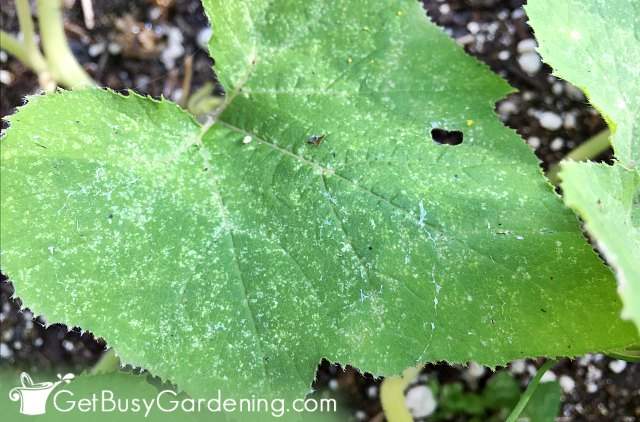
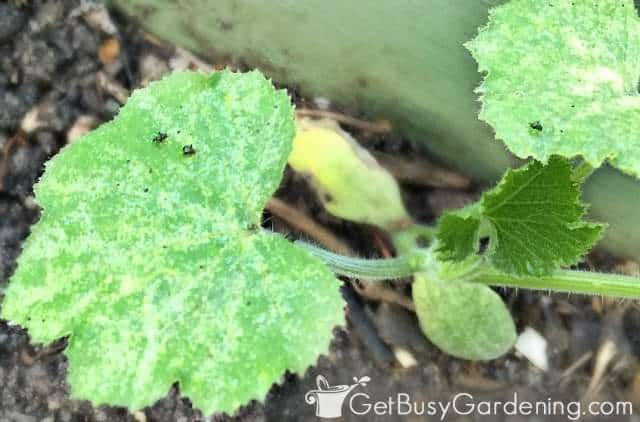
Often the first indication of an infestation is faded, yellowing, or splotchy looking leaves. When you take a closer look, you can see the tiny beetles crawling around on the plant.
Adults cause the most damage by chewing irregular holes or pock marks in the leaves. Sometimes the holes are small, but they can be fairly large too. The larvae usually cause little or no damage.
How To Control Flea Beetles
Getting rid of flea beetles completely isn’t really an achievable goal. Most of the time, you just have to control them long enough for the seedlings to outgrow the damage, and the problem will disappear.
Once the plants are large, the beetles aren’t as much of a concern. The population will go down by summer, and your plants will be mature enough to withstand the damage.
It’s not too difficult, and there are several natural treatment methods that are very effective to protect your baby plants from getting too much damage.
Related Post: How To Control Garden Pests Naturally
How To Treat Flea Beetles Organically
There’s no reason to use toxic chemical pesticides to get rid of flea beetles. Yay! Below are the most effective organic treatment methods you can try. I recommend combining several of them to see what works the best in your garden.
Neem Oil
Neem oil is a naturally occurring insecticide that kills bugs. It also has a residual effect, so you don’t have to spray it directly on them (which is great, since the beetles tend to jump away when you start spraying anyway).
While it can kill some of them right away, it does take some time to get rid of flea beetles completely, especially when the population is large. But it’s a very effective long-term solution. Learn how to use neem oil here.
Insecticidal Spray
Soapy water will kill flea beetles on contact. It’s easy to make your own by mixing 1 teaspoon of mild liquid soap with 1 liter of water, or you can buy a pre-mixed organic insecticidal soap.
These sprays will quickly kill the adults, but they don’t have a residual effect. So they’ll only work if you spray them directly on the beetles.
Diatomaceous Earth
Diatomaceous earth (DE) is another great option for controlling flea beetles organically. It’s made out of tiny pieces of ground up fossilized organisms.
The fine powder gets under the shells of the beetles, and works like tiny bits of glass to kill them. Sprinkle it around the base of the infested plants, or directly on the beetles.
Sticky Traps
Placing yellow sticky traps in your garden is another great non-toxic solution. They will attract and capture the adults as they jump from plant to plant.
They could also capture other destructive bugs in the process, so this one can be a double bonus!
Beneficial Nematodes
Beneficial nematodes are microscopic organisms that will attack and kill the larvae in the soil. They are completely harmless to humans and pets, and won’t hurt beneficial insects.
An added bonus is that they will kill the larvae of many other types of destructive bugs too (like Japanese beetles). Learn more about using beneficial nematodes in your garden here.
Repellent Plants Or Trap Crops
Some gardeners like to use plants that flea beetles love the most to lure them away from their main vegetables. These are called trap crops.
I know from experience that radishes and salad greens work great for this purpose. But you have to treat them like “throw away” plants, so you won’t be sad when they get destroyed.
Related Post: Natural Garden Pest Control Remedies & Recipes
How To Prevent Flea Beetles
If you struggle with controlling flea beetles in your garden, there are a few things you can try that will help to prevent a major infestation.
- Clean up your garden: The adults overwinter in leaves and other debris leftover in the garden. So be sure to always clean out your vegetable garden in the fall.
- Till the soil: Adult flea beetles can also overwinter in the soil. Tilling or turning your garden soil in the fall and/or early spring will expose them and help to kill them.
- Delay your plantings: Since they emerge in early spring and cause the most damage on young seedlings, try waiting a few weeks before planting everything. This will give the plants more time to mature so they can withstand the damage better. Plus, the beetle population may not be as high.
FAQs
The adult beetles come out of hibernation shortly after the ground thaws and temperatures start warming up in early spring.
No, flea beetles do not bite. They only feed on plants.
They can overwinter in the mulch and leaf debris, but they don’t live in the mulch. Their larvae lives in the soil.
There are several beneficial predators that will eat the adults or the larvae, including ladybugs, predatory wasps, and beneficial nematodes.
Flea beetles are harmful to small plants and seedlings. But they are not harmful to humans or pets.
No. In some cases, mulch can actually help with controlling flea beetles by protecting the soil. But mulch doesn’t always help with getting rid of them.
No. Don’t let the name confuse you. Flea beetles are not even related to fleas, they’re in a whole separate family. They just get their common name because they have long back legs and jump around, so they look like fleas.
Controlling flea beetles in your garden can be frustrating. But with so many effective organic treatment options to choose from, there’s no reason to use chemical pesticides. Just be persistent with your treatments, because you can’t get rid of them the first time you try.
Share your experiences or tips for controlling flea beetles in the comments section below.

James says
My experience with herbs and flea beetles is that they do nothing to deter the pests. I had several plants in direct proximity of my eggplant and tomatoes. The eggplant were totally infested.
James says
I would like to add to the list of predators, toads.
Karen says
They say “ they do not bite” but I believe these are what I’m being attacked by when I work in a bed or water. Small, black, painful and cause a welt or not under the skin. Pretty itchy too
Amy Andrychowicz says
It may be some other kind of bug that’s biting you.
David Blackwell says
Will container growing eggplant in a huge pot prevent them from hopping or climbing into it? How far do they leap vertically?
Amy Andrychowicz says
I’m not sure how high flea beetles can jump, but using a tall pot is certainly no guarantee they won’t get into the soil. Even if they can’t jump or crawl that high, they could also travel in other ways, like by wind or attaching themselves to our clothing to hitch a ride, so you’ll never really know where they came from.
Lynn says
My vegetable garden is overrun with flea beetles this year. I’ve never had them before!
Many thanks to all who have shared advice about controlling and/or eliminating these voracious pests. I plan to purchase some nematodes to apply before it gets too cold here – northern Nova Scotia – in the hope that I can drastically decrease the larvae before they get to comfortable in the soil for the winter. I will also be using DE (love this stuff for all kinds of applications) and sticky traps in an attempt to rid my garden of the adult beetles.
I lost most of my crops this summer because I did not identify the flea beetle soon enough. Very frustrating!
Amy Andrychowicz says
Oh man, that is super frustrating! I’m glad you finally know what they are, and have tons of tips for controlling those darn flea beetles! I hope all of those remedies you’re going to try will get rid of them in your garden! Good luck.
SweetCaroline74 says
Basil does not repel flea beetles, unfortunately. The only thing being eaten right now is my basil! Well, that’s where I noticed the damage at first anyway… I’ll check the rest of my patio garden closely, just to be sure.
Amy Andrychowicz says
Oh bummer, sorry to hear your basil is being demolished by flea beetles! Interesting because they are eating everything in my one bed EXCEPT for the basil (and other herbs). Those darn critters, they don’t follow any rules. LOL!
SweetCaroline74 says
Maybe they settled for the basil because they don’t like my other offerings (lemon verbena, mint, lemon thyme, rosemary, garlic chives, and tomato)?
Amy Andrychowicz says
That could be. Flea beetles attack my tomatoes when they are still seedlings, but by the time the plants have grown larger, they don’t bother them. I’ve never had flea beetles on any of the other plants you mention.
Mrs Fiona Gayther says
Yes, flea beetles DO bite. I had a bite from one which bled slightly and I then had an allergic reaction which resulted in huge blisters on my wrist and cellulitis.
Amy Andrychowicz says
Humm… I think that maybe you got bit by a different type of bug. Flea beetles do not bite humans. The only feed on vegetation. Maybe it was a common flea? Those definitely bite, and are the ones that get into your pets fur. They do not feed on plants. Two totally different bugs.
Marko says
I never heard of flea beetles till this year. Seems like a lot of people are having problems with them including myself this year. I used DE. And beneficial Nematodes.
Amy Andrychowicz says
Sorry to hear that you have flea beetles for the first time this year. They are worse some years than others. Hope the DE and nematodes do the trick.
Cate says
My local nursery swears by wood ash if you find diametaceous earth too expensive. Sprinkle it on like your would DE. I’ve been using it on the flea beetles for about a week now and it seems to help alot. Another method 75% wood ash and 25% DE.
Amy Andrychowicz says
Oh wow, I’ve never heard of using wood ash for controlling flea beetle infestations. Awesome, thanks for sharing that tip!
Mary-Frances Lannigan says
wood ash doesn’t work
Sheila says
These creepy critters ate my beautiful garden last year at harvest time! We live in the country and when the speciality crops were taken off and the flea beetles lost their food source they moved right in and went to town on my garden.
What I’m really wondering is how or if I can treat the soil before anything gets planted to kill off the previous years infestation?
Please help!!
Amy Andrychowicz says
Tilling the soil in the spring will help to kill the eggs/larvae. You could also try introducing beneficial bugs like nematodes or ladybugs. Planting flowers that attract beneficial insects will also help keep a better balance, and fight those nasty pests like flea beetles.
Gardener Lisa says
Hey Amy,
We started a new urban farm downtown Raleigh, NC and also had some massive investations of flea beetles. We used a food-grade Diatonaceous Earth and sprinkled it around the base of the plants and on the top of the plants (using a hand held strainer). This really helped!
Amy Andrychowicz says
It’s great to know that the diatomaceous earth worked so well for you to control your flea beetle infestation! Thanks so much for sharing your experience.
Helen Opie says
One used to be able to buy diatomaceous earth by the huge (40-lb?) bag at swimming pool supply places because that is what some pool filters have in them. It is clean and has not been ‘improved’, which tends to smooth the sharp edge of those diatom skeletons so they are not quite as effective. A professor in the department of Industrial ____ (I forget) in the early 1970s told me it was as good or better than that specially made for gardens or keeping buglies out of grains & other foods.
I start most of the leafy things bugs like in flats or cells and keep them out of the garden proper until they are big enough to withstand flea beetles. The beetles get less prolific after their first bloom and are usually gone by June 15 (zones 4 – 6 here); to everything their season. I notice market gardeners around here seem to put lightweight row covers over what seem to be acres and acres of veggies, so that might work. Re-use it. Some people recommend laying tinfoil under the plants; the reflected light makes the beetles uncertain where those leaves are since they are used to having light above and dark below. This may be why straw mulches work, too: they’d make the soil lighter than expected and confuse those beetley beasts.
Amy Andrychowicz says
Wonderful! Thanks for the info about DE, and also for sharing your experience, and so many great tips for controlling flea beetles!
Nana B says
My local Home Depot carries reasonably large bags of diatomaceous earth (5lb is a pretty big volume since it’s so light) in the section for controlling house pests (mice, ants, etc). I’ve had good luck mixing a few tablespoons into a quart of water and using that as a spray. Be sure to rinse out the sprayer afterwards, though, or it will clog!
Didn’t have much luck with nematodes. Just got in a batch of ladybugs and I’ll see if that helps.
Laying down fresh soil or compost helps too. I think the beetles are surface-dwellers, so perhaps burying them under a few inches kills off a lot. That works with certain fungal blights. I also read that flea beetles are repelled by work castings, which may explain why compost helps.
Nana B says
LoL *”worm castings,” not “work castings”
Joe Larose says
I guess I'm not the only one with flea beetles, they are feasting on my tomato leave seedlings. So far they don't seem to have slowed down growth but I just noticed the mass holes this weekend. Searching the web there doesn't seem to be a one fix solution and of course I don't want to use any chemicals. They are attacking my arugula too, I guess they were the culprits last year too but they seemed to have spread to the tomato leaves and quite possibly even my cucumber leaves. We had a very very mild winter in Montreal as well. Someone suggested soaking rhubarb leaves in water overnight and spraying that on, I will be attempting this in the coming days.
Amy Andrychowicz says
Sorry you're having flea beetle issues too. I’ve never heard of spraying rhubarb on the plants to deter them, that’s interesting. Please come back and let us know if that works for you.
PlantPostings says
I'm having some issues with my Hollyhocks and Clematis. I wonder if flea beetles are the problem pests. Coffee grounds and mint leaves–hmmm, I might try that! Thanks!
Amy Andrychowicz says
Sorry to hear your plants are under attack, that’s never fun. I hope the coffee grounds and mint leaves will work to deter the flea beetles!
Anonymous says
I too had flea beetles early this spring. I have used beneficial nematodes in the past and they really help. I will be spraying some into the ground in a few weeks. They should cut my flea beetle population down plus get other nasties in the soil as well.
Amy Andrychowicz says
Thanks for sharing your experience with using beneficial nematodes to control flea beetles. Good to know they worked so well for you!
Lisa says
I moved over the winter to a house that needs a yard makeover so I'll be container gardening at least this year. I seen any pests yet except for the mammoth gnats that keep chomping on the back of my neck! I was going to put everything in their pots this weekend? Maybe I should wait a bit longer? What do you think? Are flea beetles primarily an issue for the ground plots, or can containers get them too?
Amy Andrychowicz says
As long as you use fresh soil in your containers, and keep them out of the garden, then you probably won’t have to worry about flea beetles getting into them. However, they can be found in any type of soil, so they definitely could get into the soil in your pots too. I think this is one of those things that where there's dirt, there could be flea beetles. So, once they’re outside, your seedlings are at risk in the seed trays as much as they would be in the pots.
RandomGardener says
Oh, my! I haven't planted anything yet. But I am sooo.. worried. Flea beatles sound nasty to get rid of. I wonder how mulching would help…. Does it affect all vegetable plants?
Amy Andrychowicz says
As far as I know, flea beetles don't discriminate, and will feed on any vegetable. I've heard they like cole crops the best (which seems to be true in my garden too, those and the peas). But I have had flea beetles on pretty much all types of vegetable seedlings, and even a few of my annuals.
Michele says
Great plan of attack for fighting those annoying flea beetles. I'm so worried what the effects of this mild winter will be over garden season in regards to pests.
Amy Andrychowicz says
I've heard that the bugs could be really bad this year too, but that includes the good bugs too, right? (hopefully!) If so, they should also help control the flea beetles. 🙂