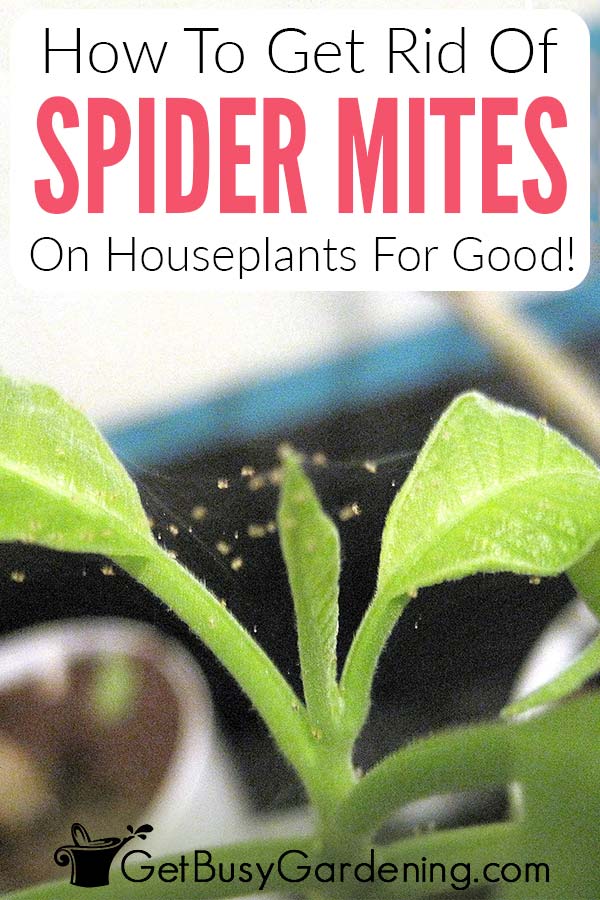
There is nothing more frustrating than finding a spider mite infestation on one of your beloved indoor plants. They are one of the most destructive pests, so it’s very important to get rid of them as quickly as possible.
The good news is that they’re pretty easy to control using natural treatment methods, and you’ll be able to eradicate them quickly.
In this detailed guide, I’ll show you all you need to know about getting rid of spider mites on your plants for good, and how to prevent them from ever coming back.

What Are Spider Mites?
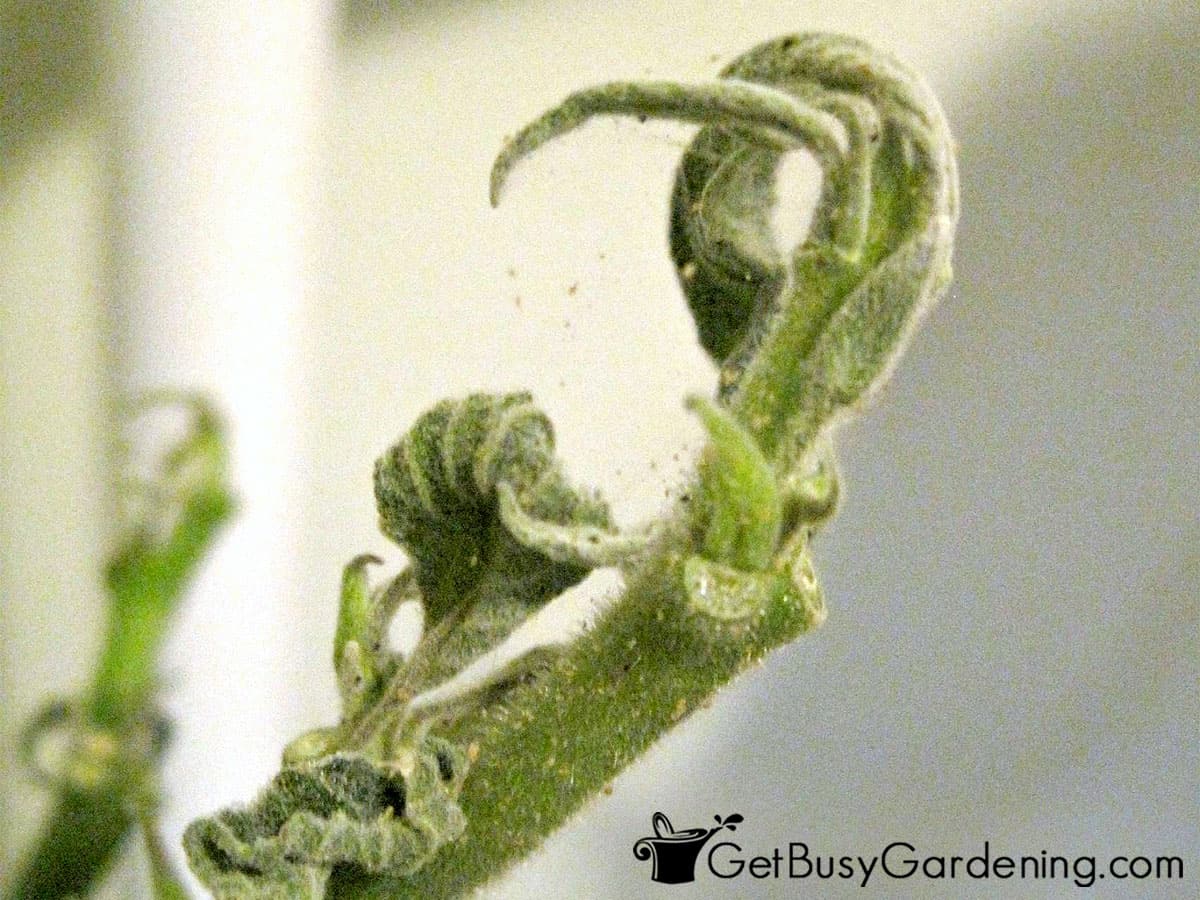
Spider mites are tiny bugs that attack many different types of plants, and they can be a major problem indoors. Though they are arachnids, just like ticks and spiders, they only feed on plant cells.
Since they’re so small, you probably won’t notice them until their population explodes. By then, there can be hundreds of spider mites in a single colony, and they cause significant damage in a very short time.
These annoying pests thrive in warm, dry conditions. So our homes are the perfect breeding grounds, especially during the winter.
How To Identify Them
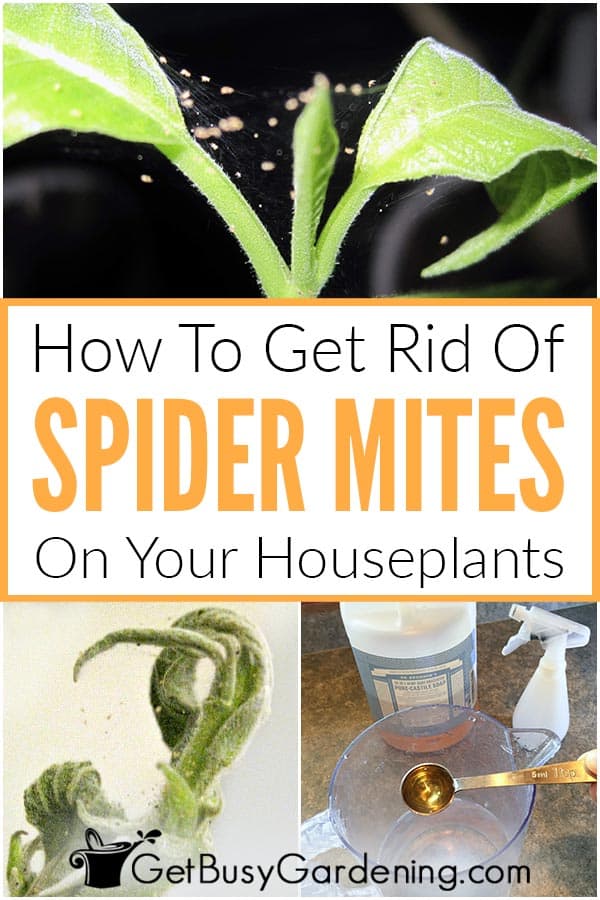
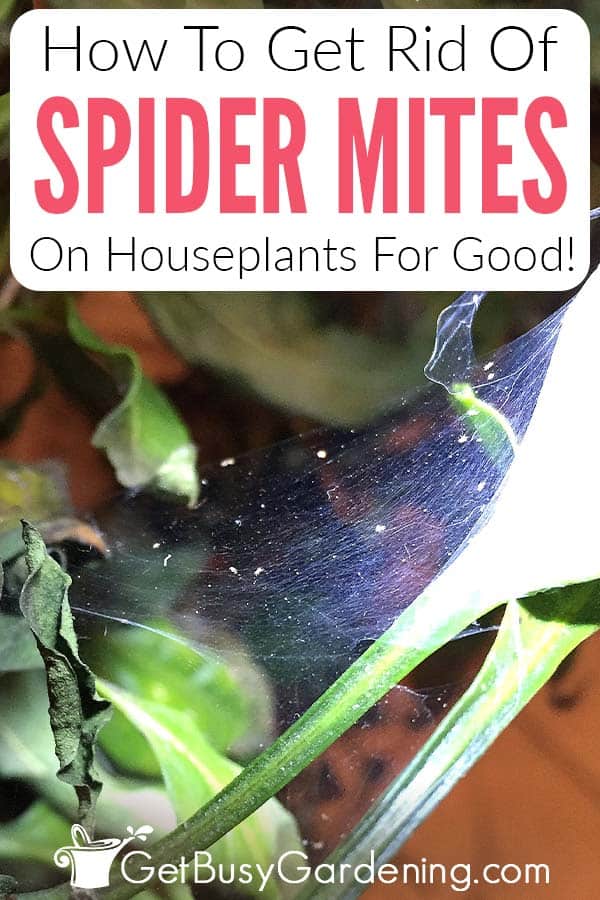
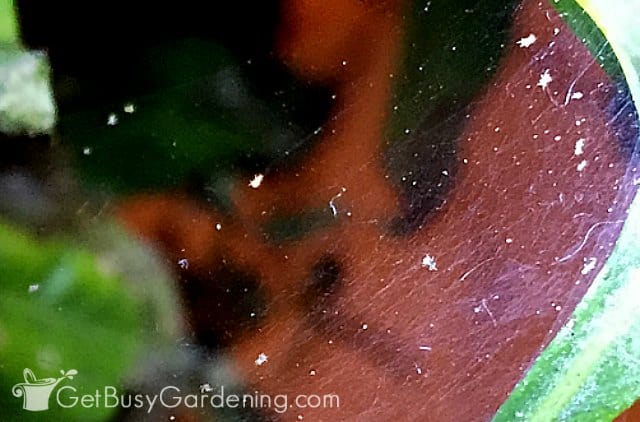
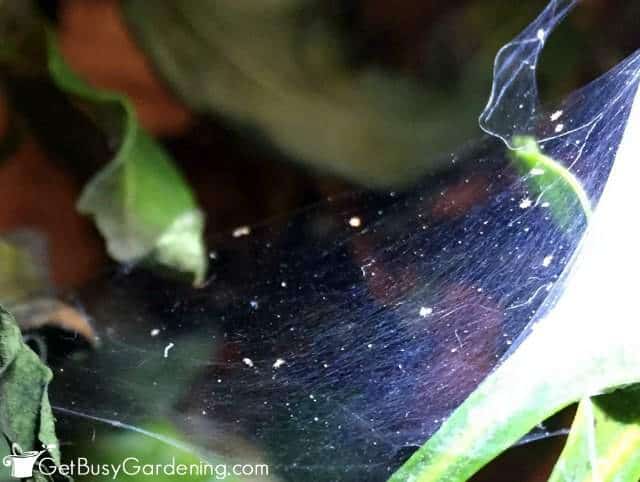
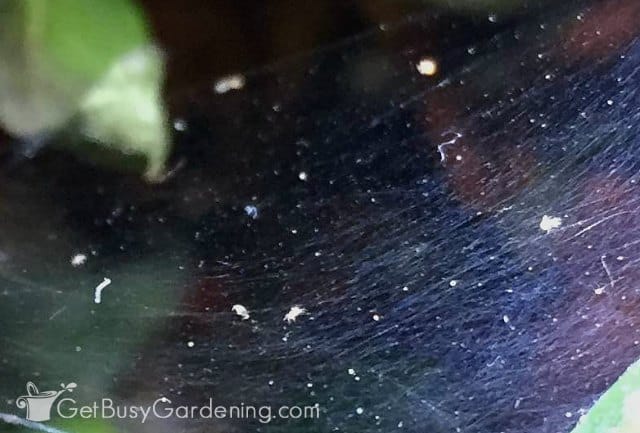
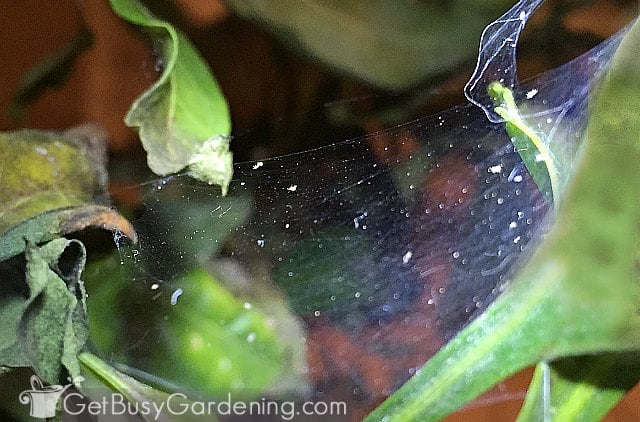
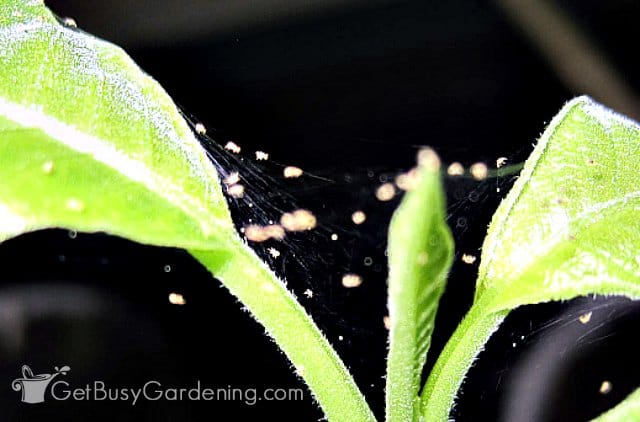
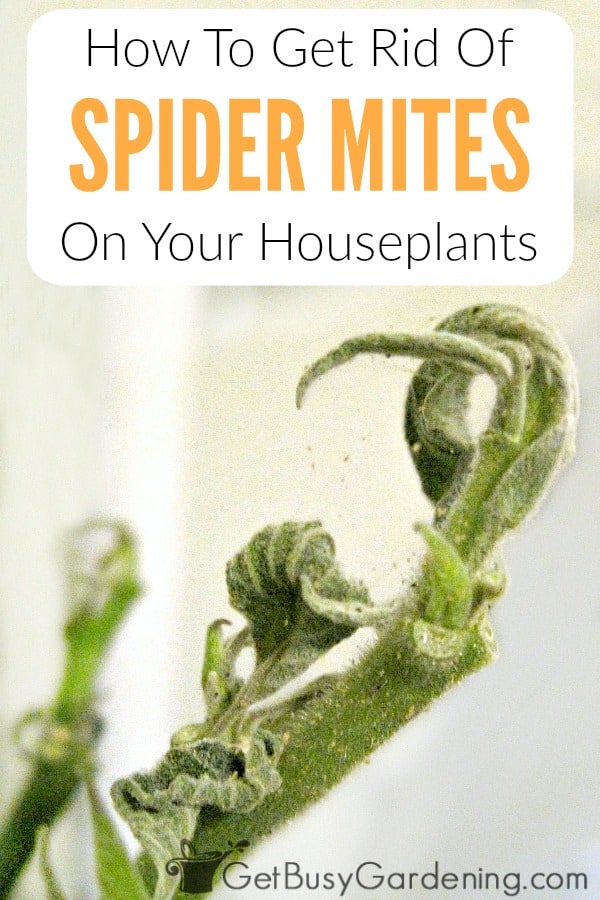
Spider mites are easy to identify, and finding their webbing on a plant is a dead giveaway. Take a closer look at the webs and you’ll see these tiny creatures crawling around on them, yuck!
Oftentimes these mites look like tiny white spiders, but they can also be tan, red, or black.
They are sneaky little suckers, and tend to start their webs on the underside of leaves. So that’s why you probably won’t notice them right away.
Rather than seeing bugs, you’ll probably spot the webs on your houseplant first. Or the leaves may just look dull and dusty, or appear dried out as if you forgot to water.
Related Post: How To Identify Common Types Of Houseplant Bugs
Their Life Cycle
At a high level, there are 4 stages to the spider mite life cycle: egg, larva, nymph, and adult. They mature very quickly, and can become full grown about a week after they hatch.
It only takes a few more weeks for an adult female to lay hundreds of eggs, and for them to start hatching.
So spider mites can multiply exponentially over a very short period of time. And, in the right conditions, their population can double every couple of weeks. Eek!
Where Do Spider Mites Come From?
The tricky part about spider mites is that they can come from anywhere, and you’ll probably never know exactly how they got on your indoor plants. But, here are a few common sources:
- Unknowingly buying an infested plant
- Repotting plants with unsterile potting soil
- Moving your houseplants outside for the summer
- Bringing flowers and vegetables inside from your garden
- Through open doors or window screens
Related Post: Where Do Houseplant Pests Come From?
Spider Mite Damage On Houseplants
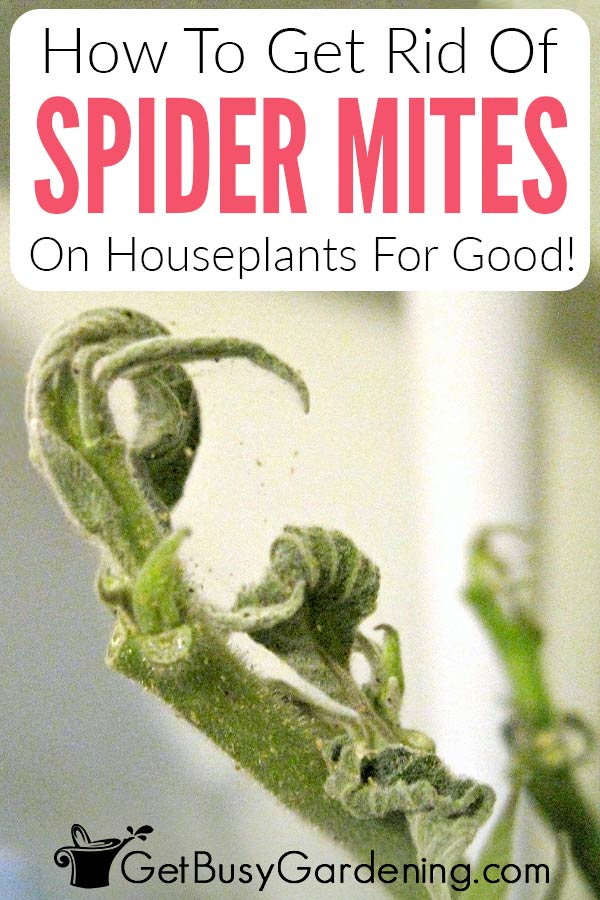
Spider mites cause damage to plants by sucking the sap out of the leaves, making them look discolored, speckled, curled, or dried up. The infested leaves will shrivel, die, and eventually drop off.
They are one of the most destructive pests, and they can heavily damage or even kill a houseplant in a very short period of time.
So it’s very important to take immediate action to get rid of spider mites as soon as you discover them.
How To Get Rid Of Spider Mites On Houseplants
Once you discover an infestation, it’s crucial to act fast to get rid of it before it spreads to the rest of your plants.
The first thing you should do is contain the problem immediately. So quarantine the infested houseplant and inspect all of the surrounding ones for spider mites. Then you should clean the plant.
To do that, I bring mine to the sink or bathtub and wash the leaves with either insecticidal soap or a mild liquid one mixed with water. Be sure to wash the undersides of the leaves too, and rinse the plant well afterward.
Spider Mite Treatment Methods
I highly recommend using only natural and organic treatment methods to get rid of the spider mites on your plants, like the ones I have listed below. Otherwise these pests can develop a resistance to chemical pesticides in a short time.
Also keep in mind that sprays, even organic ones, can damage sensitive leaves. So you should always test them on a few leaves before treating the whole plant.
Related Post: Natural Pest Control For Houseplants
Insecticide Soap
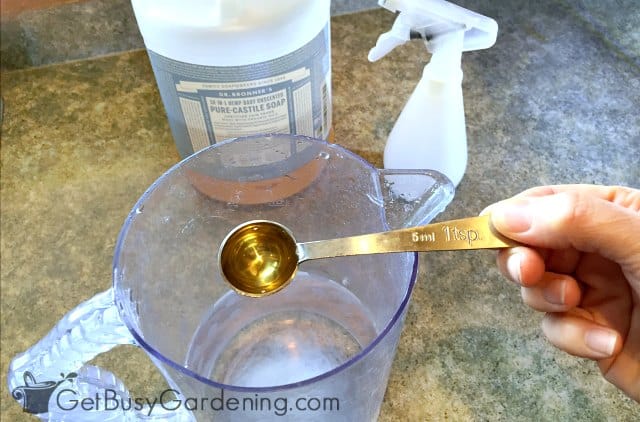
You can buy an organic insecticidal soap, or mix up a batch of my homemade spider mite spray. Here’s my recipe:
- 1 teaspoon of mild liquid soap
- 1 liter tepid water
Mix the ingredients in a spray bottle and then use it to wash the leaves. Either of these options work very well to kill the bugs on contact, but they don’t have any type of residual effect.
Neem Oil
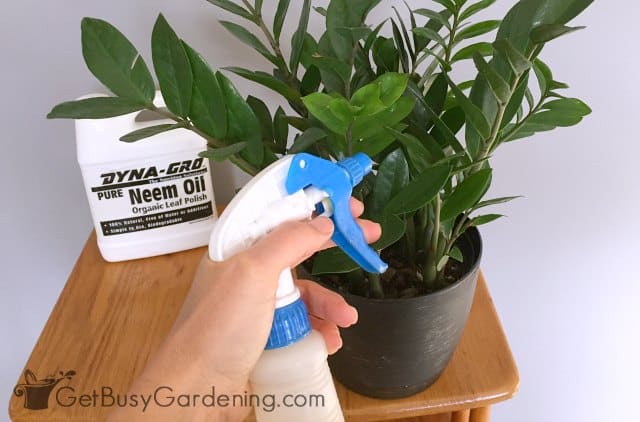
Neem oil is a natural pesticide, and it’s very effective to control spider mite infestations long term. It has a residual effect, so it also works to prevent them from coming back.
I like to buy it in a concentrate and make my own spray so I have complete control of the ingredients. Here’s my simple recipe:
- 1 ½ teaspoons of pure neem oil concentrate
- 1 teaspoon of mild liquid soap
- 1 liter of tepid water
While neem oil does kill spider mites, it can take some time to completely get rid of all of the future generations. So you have to be persistent, and treat your plant every few weeks until all signs of the bugs are gone.
Related Post: How To Use Neem Oil On Plants
Misting & Humidity
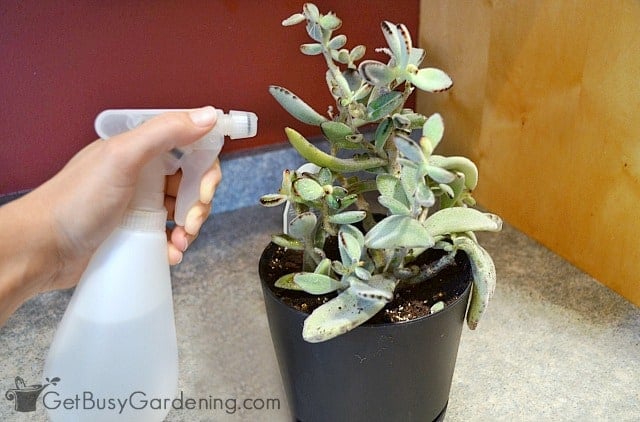
Since spider mites thrive in dry conditions, keeping the air around your indoor plants humid is one of the best prevention methods. There are a few easy ways to do this:
- Mist the leaves regularly
- Keep a container of water next to the plant
- Place the pot on a pebble tray filled with water
- Run a humidifier in the room or near your houseplants
- Place your plants next to the kitchen sink or in a sunny bathroom
If it’s really dry in your house, then I recommend getting an inexpensive indoor humidity monitor so you can monitor it.
Pruning
In addition to washing and spraying your houseplant, you can trim off infested leaves and throw them into the garbage to get rid of even more of the spider mites and eggs.
Never cut all of the leaves off though, just remove the most heavily damaged ones. Then bring the trash outside to get the bugs out of your house.
How To Prevent Spider Mites From Ever Coming Back
Though spider mites can be very persistent, especially on the houseplants they love the best, it’s pretty easy to prevent them from coming back. Here are some tips:
- Keep your plants healthy – When they’re healthy, they aren’t as susceptible to major infestations as sick ones are. Learn how to properly care for your indoor plants here.
- Maintain adequate soil moisture – Well-hydrated plants are less likely to become infested. Here’s my guide for how to water houseplants the right way.
- Increase the humidity – Spider mites thrive best in a dry environment. So mist them or run a humidifier nearby.
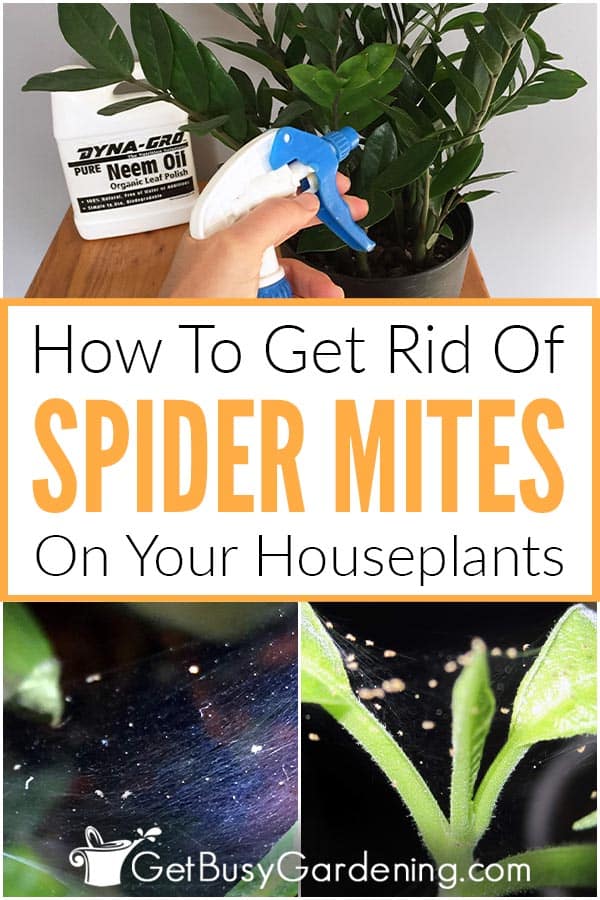
- Clean the leaves – You can use neem oil as a leaf polish, or wash the leaves with insecticidal soap to prevent an outbreak.
- Debug them before bringing them inside – If you move any of them outdoors for the summer, be sure to debug all of your plants before bringing them back indoors.
- Check your houseplants – Regularly inspect the leaves for any signs of pests so you can catch them before they get out of control. I do this every time I water.
Though dealing with recurring infestations can be extremely frustrating, it’s not difficult to eliminate spider mites from your indoor plants. The keys are to treat them immediately, be persistent in your fight, and strive to maintain healthy houseplants.
If you’re sick of battling bugs, then my Houseplant Pest Control eBook is for you. This eBook is jam-packed with information about how to get rid of bugs on indoor plants using organic methods. It shows you how to identify common pests so you can quickly and easily get rid of them, and prevent recurring infestations. Download your copy today!
More About Houseplant Pest Control
- How To Get Rid Of Houseplant Bugs Naturally
- How To Get Rid Of Gnats In Houseplant Soil
- How To Get Rid Of Thrips On Indoor Plants
- How To Get Rid Of Scale Insects On Houseplants
- How To Get Rid Of Whiteflies On Indoor Plants
- How To Get Rid Of Aphids On Houseplants
- How To Get Rid Of Mealybugs On Your Houseplants
Share your tips for getting rid of spider mites on houseplants in the comments below.

Janine Sheatz says
I get mealy bugs a lot and also a copper colored splotches on my jade plant that weren’t there before I put them out on the porch
Amy Andrychowicz says
Oh no, sorry to hear your plant is having issues! The splotches could be damage from the bugs, or it could be from sunburn, overwatering, or even scale insects (here’s how to get rid of those). And here’s how to get rid of mealybugs.
Gina says
I made the horrible mistake of not checking a purchase plant before bringing it inside – in the 39yrs I’ve been buying plants I’ve never had bugs on them before- Do I need to rinse the neem oil mixture or the Bronner baby castile soap/water off of them
Amy Andrychowicz says
I recommend rinsing off the soap after washing the plant, but you can let the neem oil dry on the leaves.
Grayson says
Hi! I’ve got spider mites on my English ivy (thank god it’s alone in the room) and got some Castile soap for insecticide spray- what I ended up getting from a local refill store is ultra-concentrated though, much thicker than Dr. Bronner’s. Do you have any ideas advice for diluting it? I feel like I should use less, but I’m not sure how much!
Amy Andrychowicz says
Oh no, sorry to hear your plant has spider mites! Oh man, they LOVE ivy, booo! I’m glad it’s isolated too, it’ll be so much easier to get rid of the mites. I would follow the instructions on the label for how to dilute the type of soap you bought. It’s hard for me to give advice on that, since I don’t know the brand and haven’t used it myself. Good luck!
LGS says
Hi! Once you spray a plant with the insecticidal soap, how many subsequent spray treatments should you do as follow up land how far apart?
Amy Andrychowicz says
Most types of insecticidal soaps don’t have a residual effect, but neem oil does, so you’ll need to spray more often if the product you’re using doesn’t contain neem oil. I would recommend weekly at minimum, or every few days until you no longer see signs of the spider mites. Otherwise, if you use neem oil, you can treat the plant every few weeks, then drop down to monthly once the mites are under control.
Alexis says
Hi Amy
I’ve just treated my miniature roses for the second infestation of spider mites. Since these little nasties can come through open windows, will spraying the screen with a strong soap solution atop them from getting in?
Amy Andrychowicz says
Soap alone won’t keep the bugs from coming through your window screens. However, peppermint and citronella oils can both work to deter bugs, so you could try spraying your screens with a soapy mixture that also contains several drops of one of those essential oils. I personally have not tried it, so I can’t speak from experience.
Payal says
Hi Amy
I have two succulent plants- a tangled heart and a rapsalis. Both I think have a spider mite infestation. I can see webbing on the new shoots of the rapsalis and the spikes are shriveling and drying up… the tangled heart does not seem to have any webbing but it was sitting right next to the rapsalis and several leaves have shriveled for no reason so it made me think it’s the evil spider mites… I’ve isolated the plants, sprayed them a few times but the rapsalis leaves are so fine I’m afraid I’ll never get them out totally. I’m even considering throwing out the tangled heart….
What do you suggest ?
Amy Andrychowicz says
Oh no, sorry to hear your plants have spider mites! So frustrating. You can’t get rid of them with only a few treatments, you have to be persistent and keep treating them until all signs of the mites are gone. I’m not sure what you’re using as a spray, but I would definitely make sure it has the mild soap mixed with water, is an organic insecticidal soap, or the neem oil as I recommend in the article. Good luck!
Amy Fix says
Hi Amy,
I have 6 elephant ear plants in myt garden. Three are in the ground under a sail shade (nbeighbors just cut doiwn the shade tree) and I have 3 elephant ears in pots outside. I was gone for 2 weeks and there was a draught. My husband said he watered all pf the plants, probably once, possibly without quite enough water.
Now that I am home, the 3 in pots and the largest one in garden all have white powder along veins in the centers of the leaves and some leaves have already dried up, curled, and turned yellow or brown and drooped. I checked up close and some leaves have a few tiny white-ish bugs crawling around and there is white spider webbing under the base of some leaves, and one large leaf has a web on the top tip.
Seems like a simple case of spider mites BUT there are ALSO very small rounded black bugs crawling on some of the dying and the more healthy leaves of the largest plant, and they appear the same shape as a Volkswagon Bug, so not thrips. AND there are some tiny pointy brown bugs crawling near the central vein of a leaf, AND there are white spots and brown spots, and one brown-edged hole near the stem. AND there are some areas of one leaf on one of the potted plants that has little grainy brown sand-like deposits on the edges of the leaf near the tip.
HELP! How can there be so many problems with my beloved elephant ears after just 2 weeks away?!? I think the hot dry conditions probably helped the various pests thrive, but I have never seen so much going on in my garden before. My few houseplants are all healthy, and I will stay vigilant but I am taking two more trips this summer for one week each. Do I need a plantsitter to tend to my leaves when I am gone? Or can I do a treatment before then that will save my plant-babies?
Amy Andrychowicz says
Wow, sorry to hear your plants have so many bugs on them. They could be aphids, flea beetles, mealybugs, or scale, here’s a post on how to identify the most common houseplant pests. But, depending on where you live, it could be something else, there are a lot more outdoor bugs than indoor ones. The spots on the leaves make me think that either they are starting to go dormant, or they have been overwatered. So I would check the soil to see how dry or wet it is. But, regardless of the types of bugs they are, here are some general tips for how to get rid of them. Good luck!